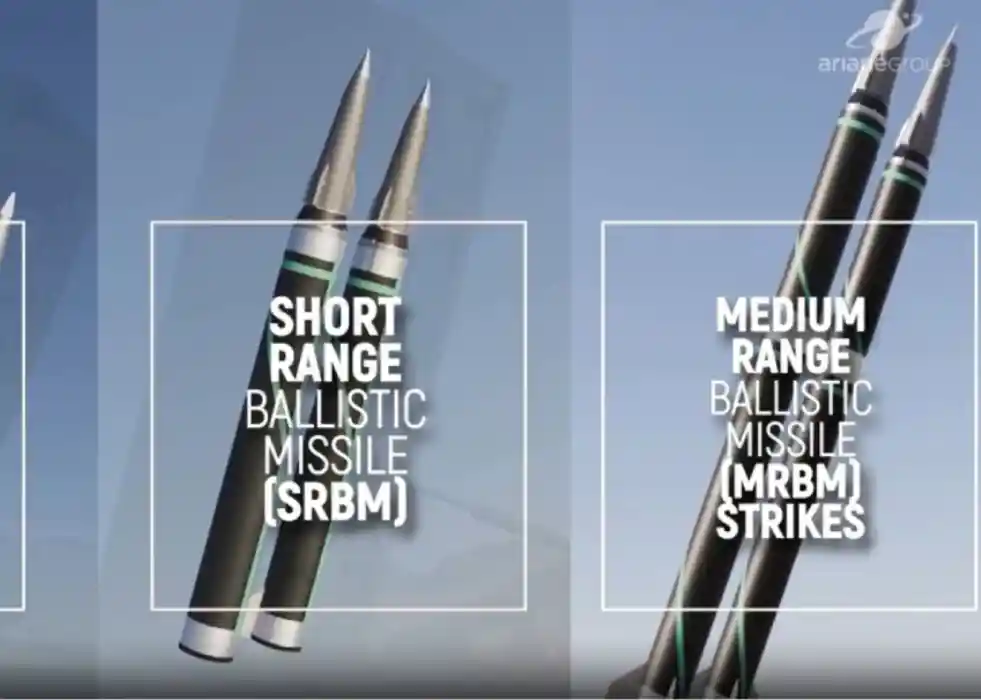
During Eurosatory 2026, French ArianeGroup displayed its follow-ups to FLP-T-150 artillery rocket as an SRBM and MRBM fitted with hypersonic glide vehicles.
ArianeGroup, with its expertise on long-range ballistic missile systems, thanks to M51 SLBM, intends to play a bigger role in the construction of France’s future land-based strike capabilities with new ballistic missiles.
The firm displayed its SRBM and MRBM projects alongside the FLP-T-150 artillery rocket, which lost to MBDA-Safran Thundart in the bid for an indigenous medium-range artillery rocket during Eurosatory 2026.
Even though ArianeGroup and Thales lost the bid in the medium-range run, it has entered a new field: France’s need for long-range strikes from land. Thanks to its standing in the strategic missile field and experience with the M51 SLBM, ArianeGroup has better chances in this run.
France is already considering the adoption of the LCM cruise missile based on the shipborne NCM cruise missile, but when time to target matters, ballistic missiles are more preferable, especially those with hypersonic glide payloads.
To fill that gap, ArianeGroup presented its SRBM and MRBM designs fitted with a common axissymetric hypersonic glide vehicle (HGV).
The SRBM adopts a single-stage design with a rather large booster, while the MRBM adds a second booster for another push at high altitudes to increase the separation speed and thus range. This means that the common HGV will have to be efficient in a wide range of hypersonic speeds, as one could anticipate a big difference in starting speed for the glide phase.
On the other hand, the SRBM appears to be designed for compatiblity with Thales X-Fire MLRS like FLP-T-150 while the MRBM will require a larger launch platform due to size constraints.
Another notable hypersonic weapon project from France is the ASN4G nuclear-armed cruise missile, which will succeed the supersonic ASMPA-R cruise missiles used by Rafale fighters forming the first strike leg. MBDA has undertaken the development and production with contributions in terms of research from ONERA.
Author: Kaan Azman
Editor:Özgür Ekşi